What Would Begin Do?
Rick Richman
To help evaluate Evelyn Gordon’s impassioned post regarding Israel’s possible $20 billion defense request, let me recount two incidents from the negotiations Menachem Begin conducted with the Carter administration in 1977-78 that are worth remembering today.
The first incident occurred in July 1977, when Zbigniew Brzezinski presented Begin with a draft statement regarding the just-concluded U.S.-Israel meeting. Begin told Brzezinski that the draft was acceptable — “except for two sentences.” Brzezinski asked what they were:
“Please delete ‘The United States affirms Israel’s inherent right to exist.’”
“Why so?”
“Because the United States’ affirmation of Israel’s right to exist is not a favor, nor is it a negotiable concession. I shall not negotiate my existence with anybody, and I need nobody’s affirmation of it.”
Brzezinski’s expression was one of surprise. “But to the best of my knowledge every Israeli prime minister has asked for such a pledge.”
“I sincerely appreciate the president’s sentiment,” said Begin, “but our Hebrew Bible made that pledge and established our right over our land millennia ago. Never, throughout the centuries, did we ever abandon or forfeit that right. Therefore, it would be incompatible with my responsibilities as prime minister of Israel were I not to ask you to erase this sentence.” And then, without pause, “Please delete, too, the language regarding the commitment to Israel’s survival.”
“And in what sense do you find that objectionable?”
“In the sense that we, the Jewish people alone, are responsible for our country’s survival, no one else.”
The second incident came a year later, in perhaps the tensest moment of the Camp David negotiations. In his diary entry for September 12, 1978, published last year in White House Diary, Carter wrote that Begin called him during dinner and said he “wanted to see me as soon as possible for the most serious talk we had ever had.” Carter tried to postpone the meeting until the next morning, but Begin insisted.
When they met, Begin opened by saying it was “the most serious talk in his life except for one with his idol, Jabotinsky.” Begin wanted the words “inadmissibility of acquisition of territory by war,” which appear in the nonbinding preamble to UN Resolution 242 but not in its operative text, removed from the draft Camp David accord. He told Carter he would not sign any text that included them.
Carter’s diary makes it clear that he disdained Begin’s “impassioned speech,” but the diary does not record any of the points Begin made to him. But because of a valuable new book containing the complete correspondence between Begin and Anwar Sadat — Peace in the Making, edited by Harry Hurwitz and Yisrael Medad — we can discover them.
The book contains a transcript of a recording, found after Begin’s death, of a speech he gave to Jewish leaders in New York on September 20, 1978, a week after the evening meeting with Carter. Begin told the audience that he endorsed the principle of the “inadmissibility of acquisition of territory by war” but not if applied to a war forced on Israel because of indefensible borders:
[I]f it is a war of legitimate national self-defense … then territorial changes are not only permissible, but necessary. [Applause]. Otherwise, every aggressor will not only commit, but also repeat, these aggressions. What is he going to lose? If he wins his aggressive war, he gets his spoils. If he loses, he gets back what he lost. …
[T]he Six-Day War … was thrust upon us – as three Presidents of the United States of America wrote to us since the days of June 1967. We were then threatened with extinction. There were slogans in Cairo and in Damascus and in Rabat Ammon and in Baghdad to the effect: “Throw them into the sea! Cut them down! Kill them! Destroy them!” Military orders included a passage calling for the physical destruction of the civilian population of any town which the invading armies may conquer.
We faced another Holocaust … Surrounded on all sides by overwhelming forces. By thousands of Soviet-supplied tanks, hundreds of first-line combat planes, hundreds of thousands of soldiers. With God’s help, we repelled all of them. They did not win their night; we won the day. [Applause].
And now you ask us to sign a document with those false and falsifying words: “inadmissibility of the acquisition of territory,” as a result of such a war, of legitimate self-defense, of saving a nation surrounded and attacked and threatened with annihilation?
Begin said he had refused for eight days to sign such a document and had finally asked to meet with Carter. “And this is what I told him” — that Israel was in Judea and Samaria as a matter of right, with a claim to sovereignty over the entire area; that it was “the land of our forefathers, which we have never forgotten during exile” but that “we leave the question of sovereignty open, because we want peace …. we know there are other claims.” They would be resolved later but not by a retreat to indefensible borders:
[T]hey wanted us to give them a commitment a priori … that we shall relinquish, completely, Judea, Samaria and the Gaza district, and not only give up our paternal heritage, our inherent right, the Land of our prophets and of our kings, the Land of our fathers and of our children, but also the most vital demands of our national security. … Then there wouldn’t be peace. There would be permanent bloodshed and ultimately a general war under the harshest conditions ever imagined … May I say to you a simple word: Never. [Sustained applause.]
The words to which Begin objected were removed, and three days later the Camp David Accords were signed.
Ehud Barak’s current $20 billion gambit is likely a trial balloon, an attempt to build support for a “peace agreement” in which Israel gives up defensible borders in exchange for money to help defend indefensible ones. It is not a trade Menachem Begin would have made.
Tuesday, March 8, 2011

Monday, March 7, 2011
Camp David Accords In the News
In a Washington Post article on Egypt post-Tahrir Square, New Egypt foreign minister likely to be tougher on Israel, we found this:
^
Egypt on Sunday got its second new government in less than six weeks, including a new foreign minister who is expected to take a tougher line with Israel than the government of the ousted president Hosni Mubarak did...
In one of the most significant shifts, Ahmed Aboul Gheit, Egypt's foreign minister since 2004, was replaced by Nabil Elaraby, a career diplomat who won plaudits from demonstrators for joining the crowds in Cairo's Tahrir Square shortly before Mubarak resigned. He was subsequently appointed to the council of "wise men" named by the demonstrators to help steer the country's path to democracy.
As a member of the team that negotiated the Camp David peace treaty with Israel in 1978, he can be expected to abide by all of Egypt's existing commitments to Israel, analysts and former colleagues said. But he is renowned for having voiced reservations about some of the treaty's clauses to then-President Anwar Sadat, and "will not be willing to accept Israeli excesses in the occupied territories," said Mustapha Kamel al-Sayyid, a professor of political science at Cairo University.
"Public opinion in Egypt is in favor of a less soft approach to Israel and I think he shares this feeling," he added. "It will be very difficult for him to make the kind of concessions Hosni Mubarak made to Israel," such as during the 2009 Gaza war, when Egypt closed its border with Gaza.
^
Saturday, March 5, 2011
Pictures From the Begin Run
This past Friday, March 4, the 1st Begin Run was held.
Pictures:
 the dais in Lions Fountain
 crowds congregating
 warm-up session
 Herzl Makov with Elisha Peleg, City Council Member in charge of Sports
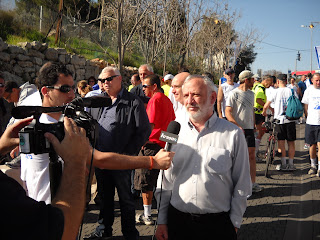 Herzi being interviewed
 Iris Belatzky, Racheli and Hila womanning the registration table
 Jerusalem's Mayor Nir Barkat (center in blue t-shirt)
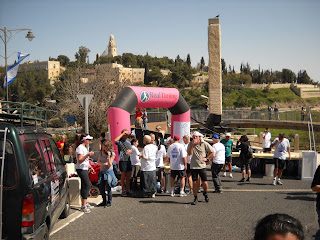 The finish line
 the Zion Square station on Jaffa Street
 the old Knesset station on King George Street
^
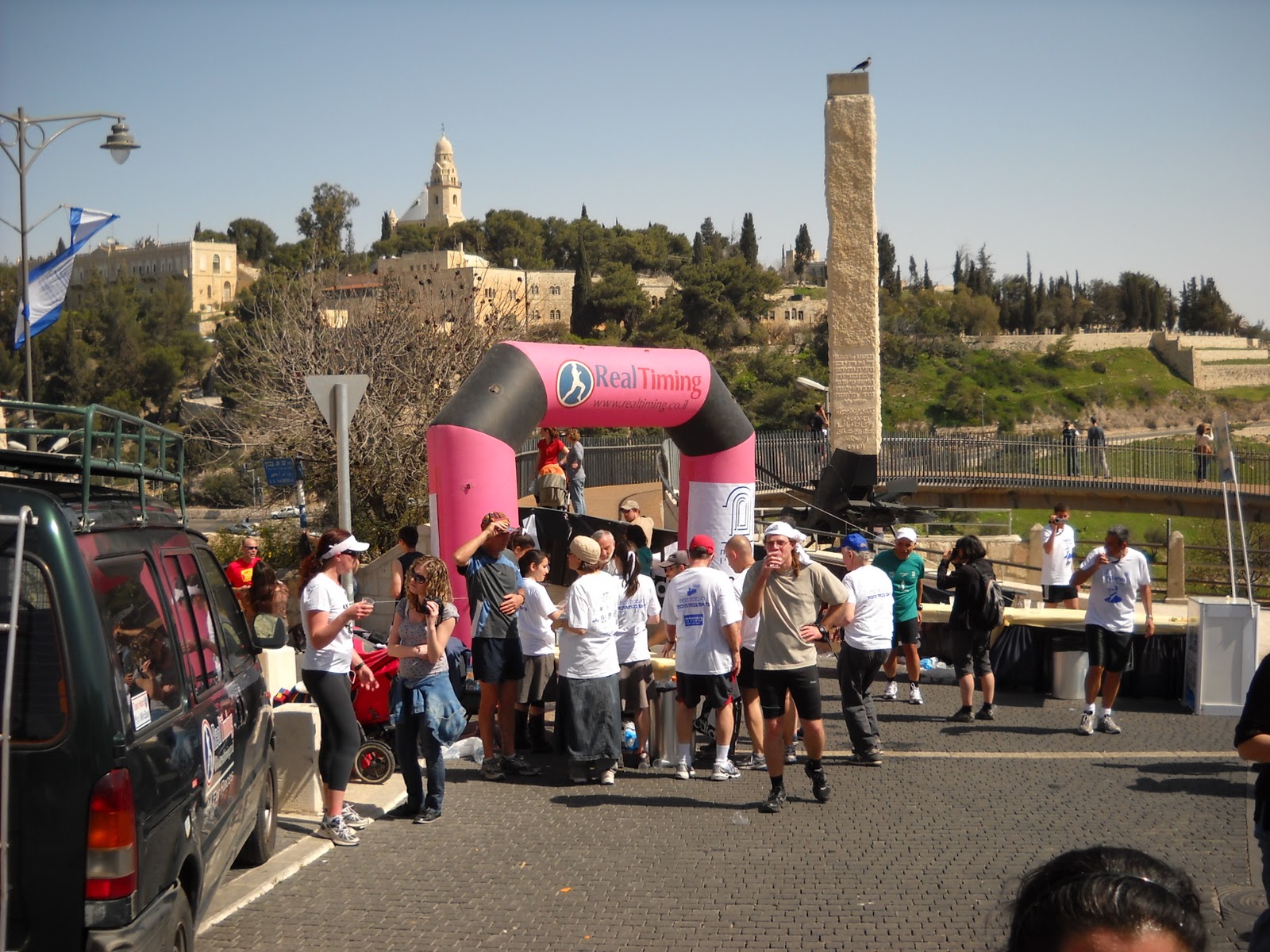
Pictures:




^
On "The Promise"
A UK-produced 'docudrama', "The Promise", has been aired on Channel 4 and has stirred controversy. The 4-part series purports to retell the last years of the British Mandate over Palestine but is flawed from a historical framework as well as seeking to reinterpret the post-1967 reality in Israel regarding the conflict with the Arabs.
Here is an excerpt from an article by David Cesarani:
Other critical pieces:
CiF Watch, D. Gold
Richard Millet
Richard Gold.
^
Here is an excerpt from an article by David Cesarani:
The Promise: an exercise in British self-exculpation
Peter Kosminsky's revisionism blames the Jews for the Middle East conflict, when the true culprit was British imperialism
Kosminsky's major TV drama The Promise, which occupied four chunks of prime time on Channel 4 on successive Sunday nights in February, dramatised the end of the British mandate for Palestine between 1945 and 1948, with a parallel story set in Israel and Palestine in 2005. It was hugely ambitious, but was it good history, let alone good television?
The series hinges on the story of a sergeant in the 6th Airborne Division, a veteran of Arnhem who saw the liberation of Belsen concentration camp, who arrives in Palestine in September 1945 with his unit. In the first episode a British intelligence officer explains to the new troops that Jews are flooding into Palestine in fulfilment of "a promise made by God". This influx is troubling the Arabs who have lived in Palestine "since time immemorial". The job of the British, he announces, is to keep the two sides apart. The paratroopers are like the "meat in a sandwich".
But, hold on a minute. It was the British who promised Palestine to the Jews as a Jewish national home in 1917 and the British who flooded Palestine with troops to protect a vital piece of imperial real estate in 1945. Zionist aspirations, which the British had fostered, and Palestinian Arab opposition to them, were a problem only in so far as they complicated British planning for the cold war.
As the series unfolds, we see British soldiers torn between compassion for the Jews and sympathy for the Palestinian Arabs. Eventually, the Jews alienate them thanks to their relentless terrorist campaign. Kosminsky depicts the blowing up of the King David Hotel in Jerusalem and the hanging of two British sergeants by the underground army of the rightwing Zionists. In one scene he shows three off-duty tommies bleeding to death after an ambush, while Jews in surrounding cafes callously sip tea and eat cream cakes.
The sergeant, through whose eyes we see the debacle unfold, also witnesses the massacre of Palestinian Arabs at the village of Deir Yassin in April 1948. By this time his allegiances are with the Arab population. On the eve of the British evacuation from Haifa he pleads with his superiors to use the army's firepower to prevent the Jewish forces from overwhelming and driving out the Arab inhabitants. He protests that Britain can't just walk away after "we've been here for 30 years keeping them apart".
This is the central conceit, and deceit, of Kosminsky's epic. The British were in Palestine for their own interests and when it no longer suited them they left. To conceal this fact he has to perpetrate a massive historical distortion. Although The Promise is insufferably didactic, no one mentions the Balfour declaration. Yet it was the British foreign secretary, AJ Balfour, who informed the English Zionist Federation in November 1917 that "His Majesty's government view with favour the establishment in Palestine of a national home for the Jewish people, and will use their best endeavours to facilitate the achievement of this object". This was the only promise that mattered because it had the force of international law. It was subsequently incorporated into the mandate that the League of Nations gave Britain to authorise its possession of Palestine. In 1922 parliament voted to accept the mandate and all that went with it.
...During the second world war Palestine was an essential military base, second only in importance to Egypt. When Rommel threatened Alexandria and Cairo in 1942, Haifa was the back-up port for the Royal Navy. Sarafand in central Palestine was one of the largest British army bases in the region. Above all, oil was piped from southern Iraq to the refineries at Haifa to fuel the Desert Rats. Palestine's geo-strategic importance increased still further after the defeat of Germany. British military planners now feared a Soviet thrust into the Middle East. They needed Haifa for the navy, Sarafand for the army, and the Ramat David airbase in Galilee from which heavy bombers of the RAF could reach southern Russia. Pressure from Arab nationalists in Egypt to close the British bases in the Nile delta added immeasurably to the value of Palestine.
This was why the British beefed up the garrison there. The paratroops were not sent to separate Jews and Arabs. They joined the 1st Infantry Division as Britain's strategic reserve in the Middle East. When the Zionist movement launched its campaign to drive the British out, British troops were deployed to suppress a Jewish insurrection that threatened Britain's route to India, its oil supplies, and its entire regional strategy. Jews and Arabs were just an irritant in a much bigger imperial conflict...However, in Kosminsky's version we are absolved of any responsibility for what is happening there. He has turned the British, who were the chief architects of the Palestine tragedy, into its prime victims. The Promise is a glossy exercise in self-exculpation. Someone must be responsible, though, and the way he rewrites history that can only be the Jews. Ultimately, Kosminsky turns a three-sided conflict into a one-sided rant.
Other critical pieces:
CiF Watch, D. Gold
Richard Millet
Richard Gold.
^
Wednesday, March 2, 2011

Tuesday, March 1, 2011
Poll on Egypt-Israel Peace After Regime Chabge in Egypt
From a poll on public opinion on the continuation of the Egypt-Israel Peace Treaty:
^
The Peace Index: February 2011
Date Published: 28/02/2011
Survey dates: 20/02/2011 - 21/02/2011
Summary of the Findings
What will happen in Egypt? The Jewish public is pessimistic about future developments in Egypt. A clear majority (70%) thinks the chances that a democratic regime will soon emerge in Egypt are low. As for the chances of an Iran-type, radical Islamic regime taking shape, opinions are divided: 49% see the chances of this as high, while 41% view them as low. In the Arab public, we see the reverse picture: a majority (74%) rates the chances of a democratic regime in Egypt as high, with only a minority (28%) seeing a radical Islamic regime as likely.
What will happen to the peace treaty with Egypt? Forty-seven percent of Jewish respondents think that the revolution will affect the peace treaty with Egypt negatively—that is, peace will be undermined or collapse—whereas 8% think the impact will be positive and the cold peace will turn warm. Nineteen percent say the revolution won’t affect relations with Israel, and the rest (27%) do not know. On this issue, the Arab public is pessimistic as well: 40% foresee a worsening of relations, 34% do not expect a change, and only 19% anticipate that the peace will “warm up” under the impact of the revolution. (The remaining 8% do not know.)
Will Hamas gain or lose? In the same spirit, half of the Jewish public holds the opinion that the revolution will strengthen the status of Hamas, while only 15% expect its status to weaken. Eighteen percent think no change will occur, and about the same rate do not know. Among the Arab respondents, the highest rate (43%) think Hamas’s status will remain as it was, but 39% expect it to strengthen and only 4% see it weakening. The rest have no clear opinion.
Is silence golden? A wide consensus of the Jewish public (85%) views Israel’s policy of silence during the revolt in Egypt as having been justified. However, over half (53%) think that the United States was wrong to support the anti-Mubarak demonstrators. In the Arab public, too, the majority (69%) thinks Israel’s policy of silence was the right one. Here, though, 70% say America was right to back the demonstrators.
^
Subscribe to:
Posts (Atom)